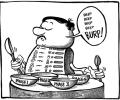
India was already in the midst of a protracted economic slowdown before the virus hit due to a festering crisis among shadow lenders and declining consumer demand and private investment. Service sector activity in India is still effectively on hold.
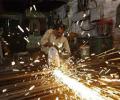
Firms hired additional hands to keep up with the production demand

Bolstered by improved domestic demand, India's services sector expanded for the fourth consecutive month in January as business activities quickened and rising business optimism is set to sustain the growth momentum, a monthly survey said on Wednesday. The seasonally-adjusted India Services Business Activity Index rose from 52.3 in December to 52.8 in January, pointing to a quicker expansion in output. The index was above the critical 50 mark that separates growth from contraction for the fourth month in a row during January.
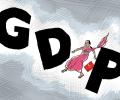
'One cannot take it that the economy has recovered, and the GST payment has increased because of that, or that production is back to January 2020 level.'
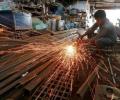
Reflecting a loss of "growth momentum", manufacturing activities in the country slowed down to a six-month low in March amid softer increases in new orders, production and employment, according to a survey.

Factory growth picked up in May.

The Nikkei India Manufacturing Purchasing Managers' Index (PMI) stood at 47.9 in July, down from 50.9 in June, its lowest mark since February 2009, and highlighted the first deterioration in business conditions in 2017 so far.

The upcoming corporate results season and the approaching Union Budget kept investors on their toes
.jpg)
The subdued labour market is likely to recover.

Sluggish rise in new business inflows and a cautious approach to costs reportedly led Indian manufacturers to shed jobs in September.

Investment trend by foreign investors will also be closely watched for stock movement

The Nikkei India Manufacturing PMI dipped from 50.3 in November to 49.1 in December.

The new orders sub-index, which includes domestic demand as well as orders from abroad, rose to 53.2 in May

Service providers' confidence with regard to the 12-month outlook for business activity remained positive.

Experts said the slowdown could be attributed to adjustments leading to destocking and the offering of discounts by companies as the government ushered in the new indirect taxation system on July 1.

The Nikkei India Services Purchasing Managers' Index, which tracks services sector companies on a monthly basis, stood at 52 in September, down from August's 43-month high of 54.7, pointing to a slower and moderate rate of expansion.

BSE Bankex and Telecom indices led the fall.

The HSBC India Manufacturing Purchasing Managers' Index for the manufacturing industry climbed from 49.6 in October to 51.3 in November on the back of a rebound in new orders and output.
Large investors track high-frequency data that is immediately available today. That data has been bullish, points out Debashis Basu.

Manufacturing of consumer goods, like food and liquor continued to improve in September.

The survey showed firms passed on a greater cost burden to consumers. Prices charged rose at their fastest pace since October.

In the United States, economic data is likely to take a back seat next week.

The trade impact of the coronavirus epidemic for India is estimated to be about 348 million dollars (approximately Rs 25 billion) and the country figures among the top 15 economies most affected as slowdown of manufacturing in China disrupts world trade, according to a UN report. Estimates published by United Nations Conference on Trade and Development on Wednesday said that the slowdown of manufacturing in China due to the coronavirus (COVID-19) outbreak is disrupting world trade and could result in a 50 billion dollar decrease in exports across global value chains.

According to bankers and economists, there is room for further rate cut by the RBI as retail and wholesale inflation rates have remained benign.

C Rangarajan, chairman, Prime Minister's Economic Advisory Council tells Business Standard that the measures taken by the government will lead to economic growth of at least 6 per cent in FY14 against a decadal-low growth of 5 per cent in FY13.

The finance ministry on Tuesday cited "green shoots" of recovery in agriculture, manufacturing and services sectors, and said the prompt policy measures taken by the government and RBI have helped reinvigorate the economy with minimal damage. Stating that the agricultural sector remains the foundation of the Indian economy, the ministry said that a normal monsoon, as has been forecast, should support the rebooting of economy.
.jpg)
The HSBC Emerging Markets Index, a monthly indicator derived from the PMI surveys, sank to 50.6 in June from 51.3 in May, signalling the weakest increase in output since May, 2009.

RBI's fifth bi-monthly monetary policy meet due tomorrow also kept the investors on their toes.
The RBI left interest rates unchanged, saying there was no substantial development on inflation or fiscal fronts to warrant a fresh reduction.
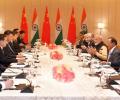
China had been trying hard to enter the Indian market, without opening its own to Indian products. There is an economic crisis in India-China relations that the Chennai Connect barely scratched the surface, points out Srikanth Kondapalli.

India's private sector activity contracted further in August, reflecting faster contractions of both manufacturing and services output, amid decline in new orders and tough economic conditions.

Expenditure cuts necessitated by slowing revenue growth, weak industrial activity worrisome portents

At this point of time, the requirement of the economy is obviously more investment, which will create more jobs and increase purchasing power that will sustain a high level of production, says K M Chandrasekhar.

The 30-share S&P BSE Sensex ended up 130 points at 25,400 and the Nifty50 rose 46 points to close at 7,759.
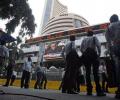
The broader markets, however, outperformed their larger peers.

TCS, Bajaj Auto, Adani Ports and Cipla were the top gainers on BSE Sensex while Coal India, GAIL, Dr Reddy's and Infosys lost the most on the index.

GDP growth in November is the second-highest since January 2012 when it had expanded 5.7%.

'India needs to adopt a more proactive policy of triggering exports to China.'
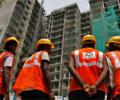
Based on the evidence at hand, Modi's goal of scripting a broader, lasting upturn appears some way off, says Rajesh Kumar Singh.

IDS-2 and raids to uncover black money stash keep receipts flowing
